
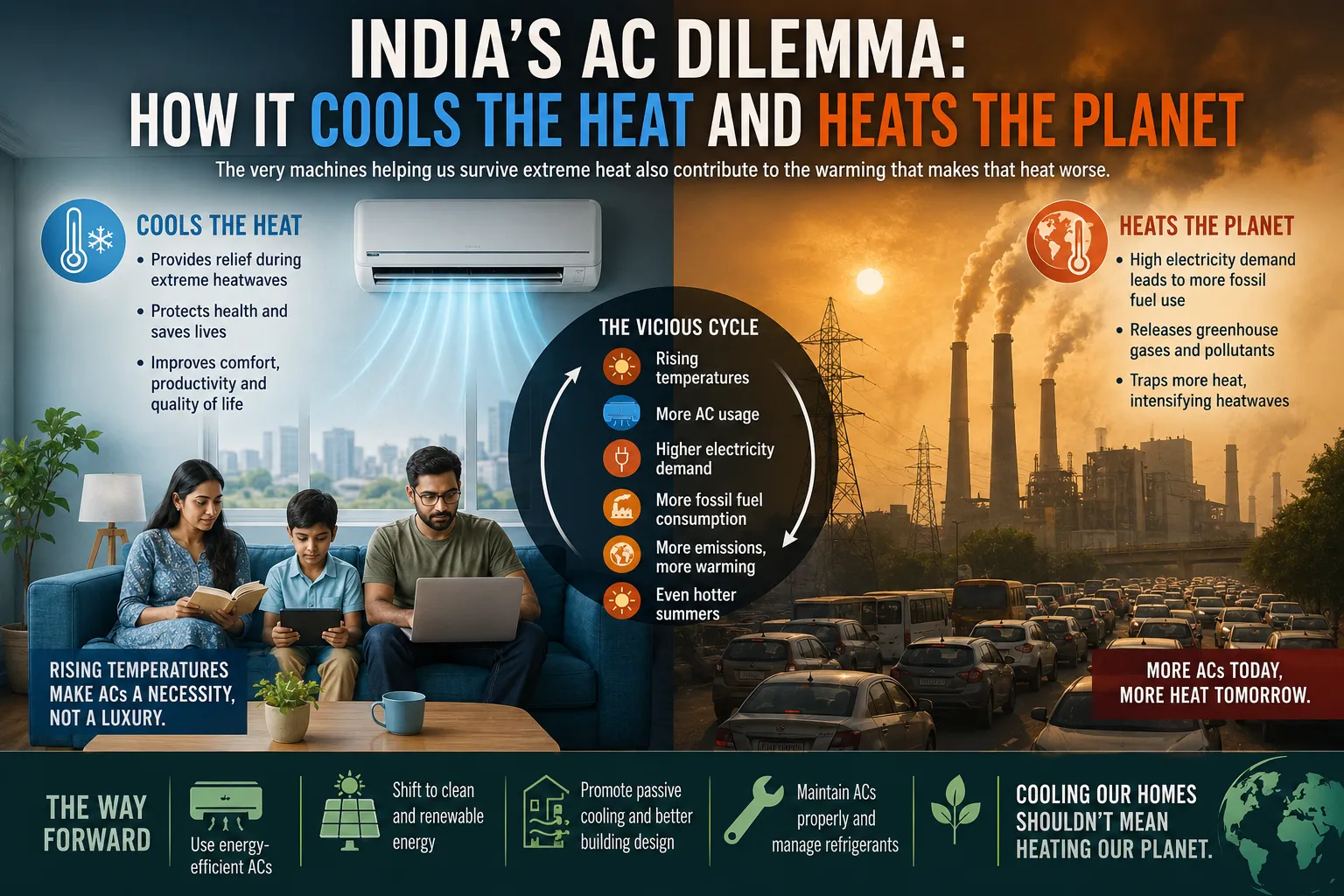
India is facing one of the most difficult climate paradoxes of the modern era. As temperatures rise to dangerous levels across the country, air conditioners are no longer viewed as luxury appliances—they are increasingly becoming tools of survival. Yet the very machines helping millions of people cope with extreme heat are also contributing to the climate crisis, creating a cycle in which cooling demand accelerates global warming and, in turn, makes summers even hotter.
This growing dependence on air conditioning reflects a deeper challenge at the intersection of climate change, urbanization, public health, and energy policy. India’s cooling crisis is no longer simply about comfort; it is about how a rapidly developing nation can protect its population from extreme heat without worsening the environmental conditions driving that heat in the first place.
Heatwaves Are Becoming India’s New Reality
India has experienced increasingly severe heatwaves over the past decade. Temperatures crossing 45°C are becoming more common in several states, while warmer nights are reducing opportunities for natural cooling. Scientists warn that climate change is intensifying the frequency, duration, and severity of these extreme weather events.
Urban areas are particularly vulnerable due to the “urban heat island” effect, where concrete structures, glass buildings, asphalt roads, and reduced green cover trap heat and raise temperatures further. Cities such as Delhi, Ahmedabad, Mumbai, and Hyderabad are increasingly struggling with prolonged periods of dangerous heat.
In such conditions, air conditioning has become essential for many households, offices, hospitals, and educational institutions. For vulnerable populations—including children, elderly citizens, and outdoor workers—access to cooling can be directly linked to health and survival.
The Rapid Rise of Air Conditioning
India’s air conditioner market is expanding rapidly. Rising incomes, urbanization, and worsening summers are driving millions of households to purchase AC units for the first time. Industry estimates suggest that annual AC sales are expected to grow dramatically over the coming years as middle-class families increasingly prioritize cooling.
For many Indians, owning an AC represents improved living standards and protection against unbearable heat. However, this surge in demand comes with enormous consequences for the country’s electricity system and environmental footprint.
Research suggests that air-conditioning adoption in India could increase several times over by mid-century as temperatures continue to rise. While this expansion reduces heat exposure for millions of people, it also significantly increases electricity demand and carbon emissions.
The Electricity Burden
Air conditioners consume large amounts of electricity, especially during peak summer afternoons when temperatures are highest. This creates massive pressure on India’s power grid.
Recent heatwaves have already pushed electricity demand to record highs, forcing authorities to increase power generation to prevent shortages. Much of this additional electricity still comes from coal-fired power plants, which remain the backbone of India’s energy system.
This creates the central paradox of India’s cooling crisis:
-
Rising temperatures increase AC usage
-
Increased AC usage raises electricity demand
-
More electricity demand leads to greater fossil fuel consumption
-
Higher fossil fuel emissions worsen climate change
-
Climate change intensifies heatwaves further
This feedback loop is increasingly being described by analysts as a “heat-power trap.”
Refrigerants: The Hidden Climate Threat
Electricity consumption is only part of the problem. Air conditioners also rely on refrigerants—chemical compounds used to cool air. Many of these substances belong to a category called hydrofluorocarbons (HFCs), which are potent greenhouse gases.
Even small leaks from AC systems can have a significant environmental impact. Improper disposal, servicing, and maintenance of cooling systems can release these gases into the atmosphere, contributing further to global warming.
As India’s cooling sector expands, managing refrigerant emissions will become increasingly important.
Energy Inequality and Cooling Access
Despite the rapid growth in AC adoption, cooling access remains deeply unequal across India. Millions of low-income households still cannot afford air conditioning, leaving them highly vulnerable during extreme heat events.
This creates a social challenge alongside the environmental one. Cooling is becoming essential for health and productivity, yet access remains uneven.
At the same time, increased cooling demand among wealthier households can strain electricity infrastructure, leading to outages that disproportionately affect poorer communities. During severe heatwaves, power cuts can become life-threatening in densely populated urban areas.
The cooling crisis therefore raises broader questions about climate justice, affordability, and public infrastructure.
The Urban Design Problem
India’s dependence on ACs is also closely tied to how cities are designed. Many urban areas have developed rapidly with little emphasis on climate-sensitive planning.
Modern buildings often rely heavily on glass facades, concrete construction, and poor ventilation systems that absorb and retain heat. As a result, indoor temperatures rise sharply, increasing dependence on artificial cooling.
Experts argue that passive cooling strategies could significantly reduce the need for air conditioning. These include:
-
Better insulation
-
Reflective roofing materials
-
Natural ventilation systems
-
Increased tree cover and green spaces
-
Shaded streets and water-sensitive urban planning
Such measures can lower indoor temperatures naturally while reducing electricity demand.
India’s Search for Sustainable Cooling
Recognizing the scale of the challenge, India has already begun exploring long-term solutions. The government introduced the India Cooling Action Plan, becoming one of the first countries to create a comprehensive national cooling strategy.
The plan focuses on:
-
Improving energy efficiency standards for ACs
-
Reducing refrigerant emissions
-
Promoting sustainable cooling technologies
-
Expanding climate-resilient urban planning
Energy-efficient AC units can significantly reduce electricity consumption compared to older models. Similarly, the expansion of solar power offers an opportunity to support cooling demand with cleaner energy sources.
Experts also emphasize the importance of behavioral changes, such as setting AC temperatures at moderate levels, improving maintenance, and combining cooling with ceiling fans and passive ventilation.
Renewable Energy as Part of the Solution
India’s renewable energy sector is growing rapidly, particularly in solar power. Expanding clean energy capacity is essential to reducing the environmental impact of rising cooling demand.
If ACs are powered increasingly by renewable electricity rather than coal, the climate tradeoff becomes less severe. However, achieving this transition requires significant investment in grid infrastructure, energy storage, and transmission systems.
The challenge is enormous because cooling demand tends to peak during hot afternoons, precisely when electricity systems are under the greatest strain.
A Future Defined by Cooling
The future of India’s climate resilience may depend heavily on how it manages cooling demand. Experts predict that the number of AC units in India could rise dramatically over the coming decades as incomes grow and temperatures continue to climb.
Without sustainable planning, this growth could place unbearable pressure on power systems and significantly increase emissions. But with the right policies, technologies, and urban design strategies, India has an opportunity to build a cooling system that protects people without accelerating the climate crisis.
Conclusion
India’s air-conditioning dilemma captures one of the defining contradictions of climate change adaptation. Air conditioners are becoming essential for protecting millions of people from dangerous heat, yet their widespread use also contributes to the warming that makes such protection necessary.
This is not simply a technological problem—it is a societal challenge involving energy policy, urban planning, public health, and environmental responsibility.
The path forward will require balancing immediate human needs with long-term sustainability. Cleaner electricity, efficient cooling technologies, climate-sensitive architecture, and equitable access to cooling must all become part of the solution.
Ultimately, India’s cooling crisis is a warning about the future of a warming world. How the country responds may shape not only its own climate resilience but also the global conversation about how societies adapt to extreme heat without deepening the very crisis they are trying to escape.
feedopr.com feedopr.com feedopr.com feedopr.com feedopr.com feedopr.com feedopr.com feedopr.com feedopr.com feedopr.com feedopr.com feedopr.com feedopr.com feedopr.com feedopr.com feedopr.com feedopr.com feedopr.com feedopr.com feedopr.com feedopr.com feedopr.com feedopr.com feedopr.com feedopr.com feedopr.com feedopr.com feedopr.com feedopr.com feedopr.com feedopr.com feedopr.com feedopr.com feedopr.com feedopr.com feedopr.com feedopr.com feedopr.com feedopr.com feedopr.com feedopr.com feedopr.com feedopr.com feedopr.com feedopr.com feedopr.com feedopr.com feedopr.com feedopr.com feedopr.com feedopr.com feedopr.com feedopr.com feedopr.com feedopr.com feedopr.com feedopr.com feedopr.com feedopr.com feedopr.com feedopr.com feedopr.com feedopr.com feedopr.com feedopr.com feedopr.com feedopr.com feedopr.com feedopr.com feedopr.com feedopr.com feedopr.com feedopr.com feedopr.com feedopr.com feedopr.com feedopr.com feedopr.com feedopr.com feedopr.com feedopr.com feedopr.com feedopr.com feedopr.com feedopr.com feedopr.com feedopr.com feedopr.com feedopr.com feedopr.com feedopr.com feedopr.com feedopr.com feedopr.com feedopr.com feedopr.com feedopr.com feedopr.com feedopr.com feedopr.com feedopr.com feedopr.com feedopr.com feedopr.com feedopr.com feedopr.com feedopr.com feedopr.com feedopr.com feedopr.com feedopr.com feedopr.com feedopr.com feedopr.com feedopr.com feedopr.com feedopr.com feedopr.com feedopr.com feedopr.com feedopr.com feedopr.com feedopr.com feedopr.com feedopr.com feedopr.com feedopr.com feedopr.com feedopr.com feedopr.com feedopr.com feedopr.com feedopr.com feedopr.com feedopr.com feedopr.com feedopr.com feedopr.com feedopr.com feedopr.com feedopr.com feedopr.com feedopr.com feedopr.com feedopr.com feedopr.com feedopr.com feedopr.com feedopr.com feedopr.com feedopr.com feedopr.com feedopr.com feedopr.com feedopr.com feedopr.com feedopr.com feedopr.com feedopr.com feedopr.com feedopr.com feedopr.com feedopr.com feedopr.com feedopr.com feedopr.com feedopr.com
