
The First Battle of Panipat, fought on 21 April 1526, is widely remembered as a turning point in Indian history. It marked the beginning of Mughal rule and introduced organized gunpowder warfare to the subcontinent. However, beyond cannons, cavalry, and military formations, historical accounts reveal a more complex and often overlooked aspect of Babur’s strategy—his use of the local environment, including village homes, as part of his defensive system.
This dimension of the battle highlights not only Babur’s tactical brilliance but also the harsh realities of early modern warfare, where civilians and settlements could become part of military planning.
The Strategic Context of the Battle
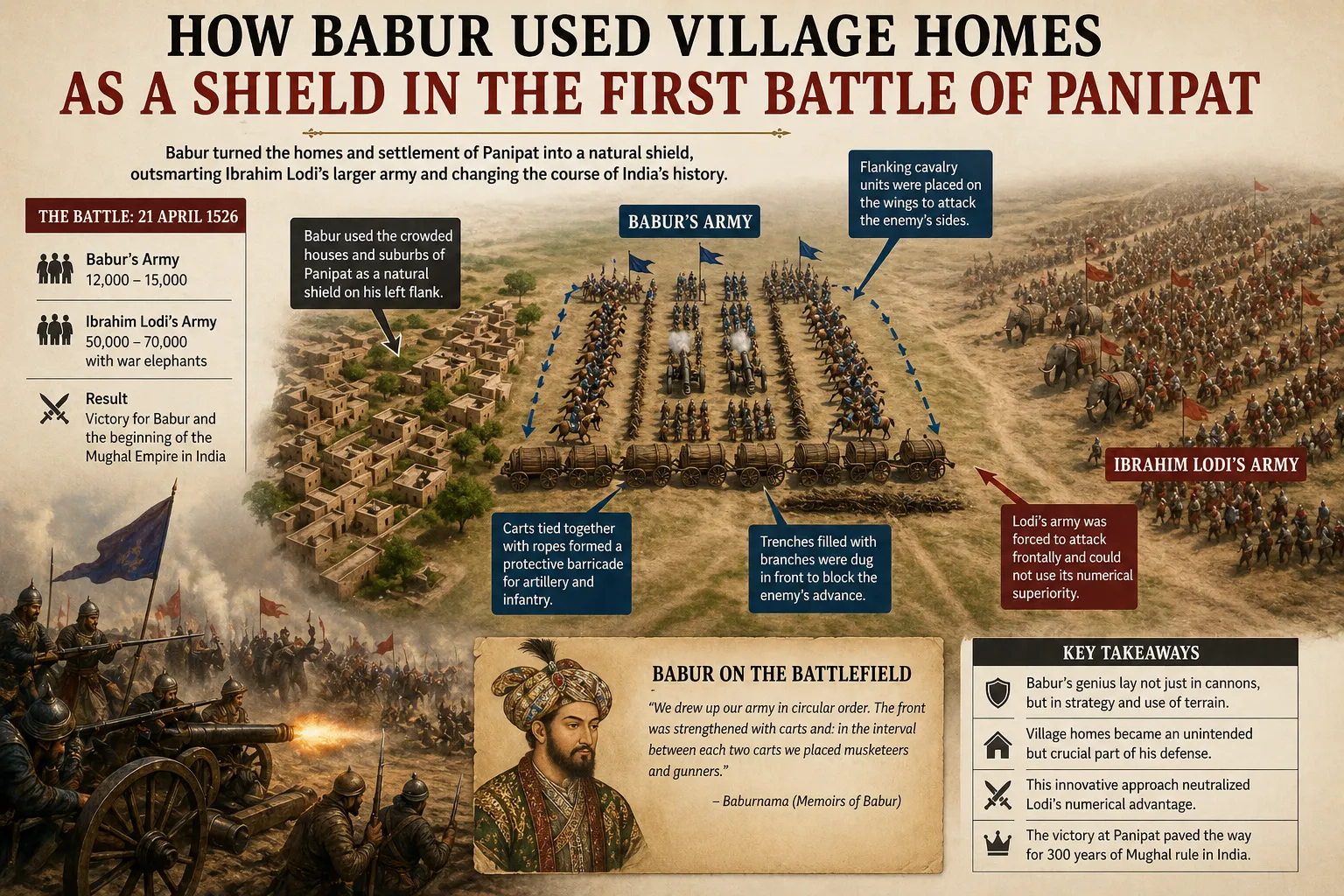
When Babur marched into North India, he faced overwhelming odds. His army consisted of roughly 12,000 to 15,000 troops equipped with field artillery and matchlock firearms, while Ibrahim Lodi commanded a much larger force, estimated between 50,000 and 70,000 soldiers, along with war elephants.
Despite being outnumbered, Babur understood that victory would depend not on brute strength but on strategy, terrain, and innovation. His approach combined Central Asian military techniques with adaptations suited to the Indian battlefield.
The Role of Terrain and Settlement
One of Babur’s most significant tactical decisions was choosing his battlefield carefully. He positioned his forces near the town of Panipat, using its built environment to his advantage. Historical accounts indicate that Babur viewed the crowded houses and suburbs of Panipat as a natural shield on one side of his army.
This meant that instead of fighting in an open plain where Ibrahim Lodi’s larger army could easily surround him, Babur anchored one flank of his formation against the town itself. The presence of houses, narrow lanes, and dense settlement effectively prevented enemy troops from attacking from that direction.
In practical terms, this reduced the battlefield to a controlled front, forcing Lodi’s forces to confront Babur’s army head-on rather than exploiting their numerical superiority through flanking maneuvers.
Village Homes as Defensive Barriers
The use of village homes was not incidental—it was a deliberate tactical choice. By aligning his army with the built-up area of Panipat, Babur transformed civilian structures into defensive barriers. These homes acted similarly to fortifications, restricting movement and creating a natural wall.
On the opposite side, Babur complemented this advantage with man-made defenses. He dug trenches filled with branches and constructed a line of carts tied together with ropes, behind which his soldiers and artillery were positioned.
Together, these elements created a hybrid defensive system:
-
One flank protected by the town’s houses and structures
-
Another flank secured by trenches and obstacles
-
The center reinforced by carts and artillery
This combination ensured that Babur’s smaller army could not be easily encircled, effectively neutralizing Lodi’s numerical advantage.
Integration with Artillery and Formations
Babur’s use of village homes was only one part of a larger, coordinated strategy. His battlefield design worked in tandem with two key tactical systems:
1. Araba (Cart) Formation
Babur arranged hundreds of carts in rows, tied together with ropes. These acted as a protective barricade for his artillery and infantry, allowing cannons to fire safely.
2. Tulughma Strategy
He divided his army into multiple units—left, right, and center—with further subdivisions. This allowed his forces to execute flanking attacks while the enemy remained pinned in front.
The village homes, therefore, were not used in isolation. They were integrated into a broader system that combined terrain, fortification, and mobility.
Impact on the Battle
When Ibrahim Lodi’s army advanced, it encountered a narrow and constrained battlefield. The presence of Panipat’s structures on one side and defensive obstacles on the other limited its ability to deploy fully.
As a result:
-
Lodi’s troops could not effectively use their numerical strength
-
War elephants, already vulnerable to cannon fire, became disorganized
-
Babur’s artillery and matchlock men maintained sustained attacks from protected positions
The battle quickly turned chaotic for Lodi’s forces. The sound of cannons frightened the elephants, causing them to trample their own troops, while Babur’s cavalry attacked from the flanks.
Ultimately, Ibrahim Lodi was killed on the battlefield, and his army collapsed, leading to a decisive Mughal victory.
Civilian Spaces in Warfare
The use of village homes as a shield raises important questions about the role of civilians in warfare. While historical records often focus on generals and strategies, they also hint at the presence of local populations caught in the conflict.
By incorporating the town into his defensive line, Babur effectively turned civilian spaces into part of the battlefield. This reflects a broader pattern in pre-modern warfare, where:
-
Settlements were frequently used as defensive positions
-
Civilian areas could become military assets
-
The distinction between battlefield and habitation was often blurred
Although detailed accounts of civilian impact are limited, it is clear that the battle was not fought in an empty landscape. The environment itself—including homes—became an active component of military strategy.
Rethinking the Narrative of Panipat
The First Battle of Panipat is often simplified as a story of technological superiority—Babur’s cannons versus Lodi’s elephants. While artillery did play a crucial role, historians increasingly emphasize that tactics and battlefield design were equally important.
Babur’s victory was the result of multiple interconnected factors:
-
Strategic use of terrain
-
Defensive innovations like carts and trenches
-
Flexible troop formations
-
Psychological impact of gunpowder weapons
-
And notably, the integration of existing structures like village homes into his defensive system
This broader perspective challenges the idea that technology alone determined the outcome. Instead, it highlights Babur’s ability to adapt and innovate under pressure.
Conclusion
Five centuries after the First Battle of Panipat, the image of cannons firing across the battlefield remains central to its legacy. Yet, a closer examination reveals a more nuanced story—one in which Babur’s success depended as much on strategy and environment as on firepower.
By using the homes and urban layout of Panipat as a natural shield, Babur demonstrated a keen understanding of terrain and battlefield dynamics. This decision helped him overcome a numerically superior enemy and secure a victory that would reshape the course of Indian history.
At the same time, it serves as a reminder that warfare has always extended beyond armies and generals. The landscapes in which battles are fought—including the homes of ordinary people—can become silent participants in history’s most decisive moments.
pulsitera.shop pulsitera.shop pulsitera.shop pulsitera.shop pulsitera.shop pulsitera.shop pulsitera.shop pulsitera.shop pulsitera.shop pulsitera.shop pulsitera.shop pulsitera.shop pulsitera.shop pulsitera.shop pulsitera.shop pulsitera.shop pulsitera.shop pulsitera.shop pulsitera.shop pulsitera.shop pulsitera.shop pulsitera.shop pulsitera.shop pulsitera.shop pulsitera.shop pulsitera.shop pulsitera.shop pulsitera.shop pulsitera.shop pulsitera.shop pulsitera.shop pulsitera.shop pulsitera.shop pulsitera.shop pulsitera.shop pulsitera.shop pulsitera.shop pulsitera.shop pulsitera.shop pulsitera.shop pulsitera.shop pulsitera.shop pulsitera.shop pulsitera.shop pulsitera.shop pulsitera.shop pulsitera.shop pulsitera.shop pulsitera.shop pulsitera.shop pulsitera.shop pulsitera.shop pulsitera.shop pulsitera.shop pulsitera.shop pulsitera.shop pulsitera.shop pulsitera.shop pulsitera.shop pulsitera.shop pulsitera.shop pulsitera.shop pulsitera.shop pulsitera.shop pulsitera.shop pulsitera.shop pulsitera.shop pulsitera.shop pulsitera.shop pulsitera.shop pulsitera.shop pulsitera.shop pulsitera.shop pulsitera.shop pulsitera.shop pulsitera.shop pulsitera.shop pulsitera.shop pulsitera.shop pulsitera.shop pulsitera.shop pulsitera.shop pulsitera.shop pulsitera.shop pulsitera.shop pulsitera.shop pulsitera.shop pulsitera.shop pulsitera.shop pulsitera.shop pulsitera.shop pulsitera.shop pulsitera.shop pulsitera.shop pulsitera.shop pulsitera.shop pulsitera.shop pulsitera.shop pulsitera.shop pulsitera.shop pulsitera.shop pulsitera.shop pulsitera.shop pulsitera.shop pulsitera.shop pulsitera.shop pulsitera.shop pulsitera.shop pulsitera.shop pulsitera.shop pulsitera.shop pulsitera.shop pulsitera.shop pulsitera.shop pulsitera.shop pulsitera.shop pulsitera.shop pulsitera.shop pulsitera.shop pulsitera.shop pulsitera.shop pulsitera.shop pulsitera.shop pulsitera.shop pulsitera.shop pulsitera.shop pulsitera.shop pulsitera.shop pulsitera.shop pulsitera.shop pulsitera.shop pulsitera.shop pulsitera.shop pulsitera.shop pulsitera.shop pulsitera.shop pulsitera.shop pulsitera.shop pulsitera.shop pulsitera.shop pulsitera.shop pulsitera.shop pulsitera.shop pulsitera.shop pulsitera.shop pulsitera.shop pulsitera.shop pulsitera.shop pulsitera.shop pulsitera.shop pulsitera.shop pulsitera.shop pulsitera.shop pulsitera.shop pulsitera.shop pulsitera.shop pulsitera.shop pulsitera.shop pulsitera.shop pulsitera.shop pulsitera.shop pulsitera.shop pulsitera.shop pulsitera.shop pulsitera.shop pulsitera.shop pulsitera.shop
infinityinspires.com codecraftes.com linklaunches.com pixelperkes.com quantumquestes.com sunshinstates.com techsthrive.com webeswhiz.com webswisdoms.com
